Vending Machine Market in Singapore (Part 1): A Southeast Asian Market Growing Steadily Despite Data Gaps新加坡自动售卖机市场观察(一):一个“数据真空”却稳健成长的东南亚市场
Analyzing Singapore's vending machine market — a Southeast Asian market growing steadily despite data gaps, and the logic behind its growth.剖析新加坡自动售卖机市场——一个数据稀缺却稳健增长的东南亚市场,洞察其背后的成长逻辑与机会。
Market Size: Two Different Definitions, Vast Difference
The widely circulated market size of Singapore's vending industry has two completely incomparable statistical definitions, with a numerical difference of up to 6x, which easily misleads industry judgment.
Euromonitor International's "Vending" channel definition, i.e., the amount consumers actually spend on productsas a statistical definition, Singapore's vending channel sales in 2024 were S$116.8 million (US$90 million),CAGR from 2019-2024 was only 2.4%, with moderate end-consumer growth.
whileNextMSC、BlueWeave、Report OceanSome third-party research institutions include equipment hardware procurement, software development, O&M services, and operator revenue all into the industry total, estimating a maximum market size of US$552 million in 2024.
This is not about who is wrong, but about "completely different definitions" — one measures "how much consumers spent," the other measures "how much the entire industry is worth." But many Chinese-language sources, and even some English reports, mix these two numbers together.
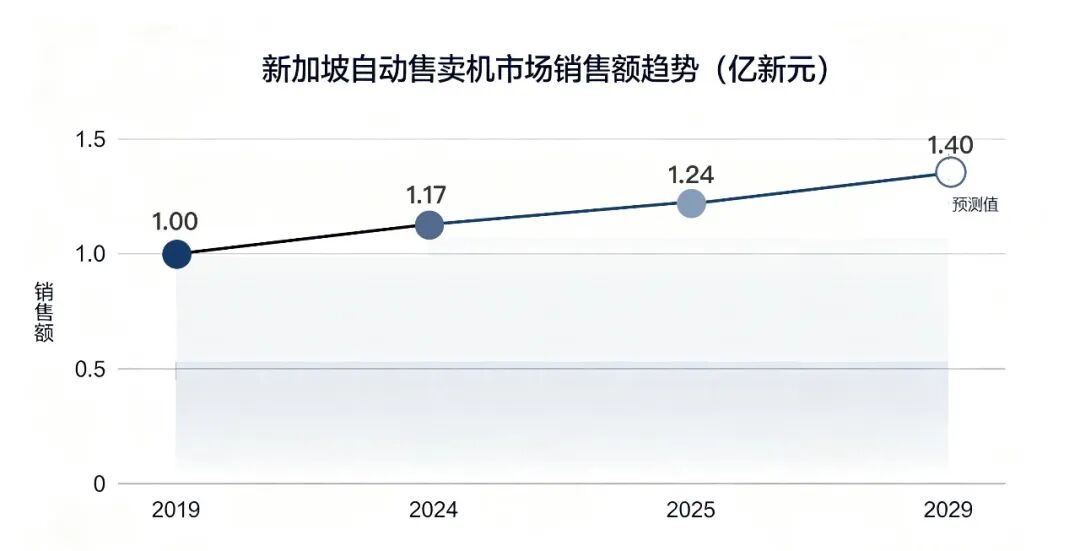
Note: This table uses the consumer actual purchase amount definition, excluding industry chain revenue such as equipment, software, and O&M.
The Stock Puzzle: 100,000 Units Is Just an Estimate
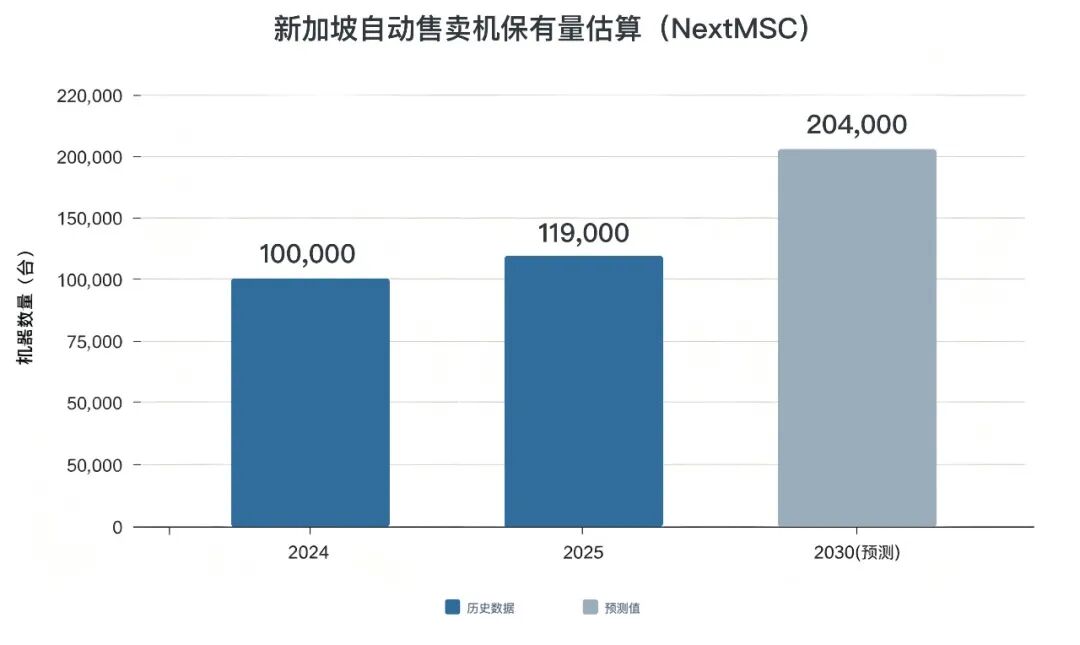
Singapore's national vending machine stock is also uncertain. Currently only NextMSC gives an estimate of about 100,000 units for 2024, but this report does not disclose its calculation logic, nor does it define statistical boundaries, so it cannot distinguish whether the count includes ticketing terminals, recycling devices, and other broad-category equipment.
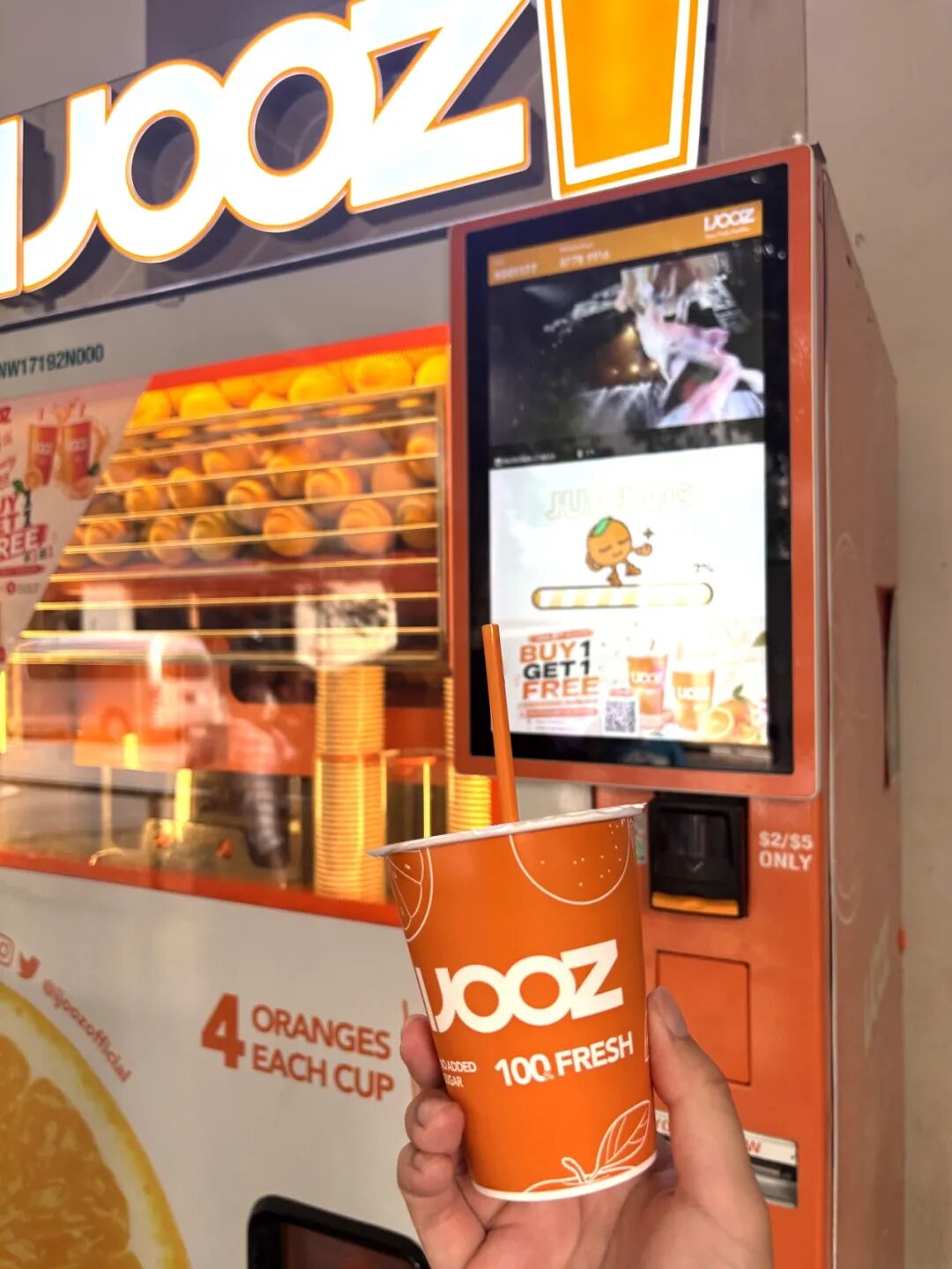
Based on public market information, top operatorsF&N and ATLAS have notpublicly disclosed device numbers, iJooz has about 1,500 machines, hot-food-focused Chef-in-Box about 500,SmartRetail about 100 machines, MTBL 110 machines,Kopi Near Me 70 machines. To reach 100,000 units, there must be an extremely long "long tail of small operators."
The market shows a typical two-hump structure: a few professional operators, plus a huge number of tiny long-tail players.
Machine density is not low, but far from saturated
Even using the "100,000 units" estimate, and calculating with Singapore's population of about 6 million and land area of about 734 square kilometers, its vending machine density is still significantly lower than Japan's. By this estimate, Singapore has about 16 vending machines per 1,000 people, while Japan, long considered a mature vending market, has a density of over 40 machines per 1,000 people.
Singapore's urban functions are highly concentrated: office buildings, residences, transit nodes, schools, and commercial facilities are closely connected. Vending machines are better suited to enter daily life through "precise locations." It does not need to be deployed on every street, but enters spaces where traditional stores have insufficient coverage but there is stable immediate demand.
Therefore, the value of vending machines is not just saving a clerk, butshrinking retail touchpoints to embed into places consumers pass through。
From beverages and snacks toward fresh food and specialty products
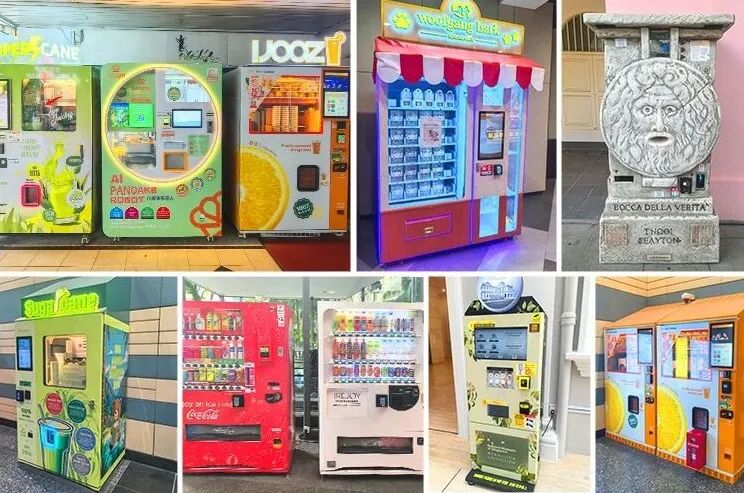
The product mix of Singapore's vending machines is changing. In the past, beverages and packaged snacks were the most common categories; today, coffee, fresh juice, hot food, chilled food, daily necessities, and local specialty products are also starting to appear in machines.
Behind this change is the combined push of device technology and consumer demand. Heating, cooling, remote monitoring, and smart payment technologies enable vending machines to handle more non-standard products.
But food vending is not simply putting products into a machine. Devices involving heating, juicing, on-site preparation, or cold chain management need to meet food safety, temperature control, hygiene maintenance, and supply chain stability requirements.
Therefore,Future industry competition is not just about device appearance and procurement price, but also about food safety and operational capability。
Overall cashless, but vending has no dedicated payment data
Singapore's overall retail is already highly cashless: bank card contactless payments, e-wallets, PayNow, and SGQR are all widely used, and cash's share of physical retail payments continues to decline. But no official agency has counted the cashless transaction ratio or QR code device coverage in vending machines. From operator cases, we can qualitatively infer that mainstream new vending machines already support NETS, credit cards, PayNow, e-wallets, and QR code payments, and pure cash devices are being phased out, but the specific ratios remain unknown.
For vending machines, payment not only affects consumer experience, but also directly impacts profit. Since the average transaction value of beverages, coffee, and other products is low, the rate difference between credit card and QR code payments continuously accumulates in high-frequency transactions.Low-fee local payment methods not only reduce cash management costs, but also help connect inventory, transaction, and consumer behavior data.
Common payment methods and rate reference for Singapore vending machines
Industry insight: This is a market where "scenarios are more active than statistics"
Singapore's unattended retail market cannot be measured by machine count alone. Its macro statistics are incomplete, but urban density, cashless infrastructure, and consumer demand for convenience have created numerous real-world scenarios for vending machines.
Future competition is not just about "how many machines are deployed," but whether the right products, payment methods, and operating efficiency can continuously meet instant consumer demand at the right locations.
What kind of definition confusion have you encountered when reading overseas industry reports? Feel free to share in the comments.
市场规模:两套口径,相差悬殊
市面上流传的新加坡贩卖机市场规模,存在两套完全不可比的统计口径,数值差距最高可达 6 倍,极易对行业判断形成误导。
Euromonitor International 的"Vending"渠道口径,即消费者实际购买商品的金额作为统计口径,2024 年新加坡贩卖机渠道销售额为 1.168 亿新元(9000万美元),2019‑2024 年复合增速仅 2.4%,终端消费增长节奏温和。
而NextMSC、BlueWeave、Report Ocean部分第三方研究机构,将设备硬件采购、软件开发、运维服务、运营商营收全部纳入行业大盘,2024 年测算出最高 5.52 亿美元的市场规模。
这不是谁错了,而是“口径根本不同”——一个算"消费者花了多少钱",一个算"整个行业值多少钱"。但大量中文资讯、甚至部分英文报告,都在混着引用。
注:该表采用消费者实际购买金额口径,不包括设备、软件和运维等产业链收入。
保有量谜题:10 万台只是估算
新加坡全国贩卖机保有量同样充满不确定性。目前仅有 NextMSC 给出 2024 年约 10 万台的估算数据,但这份报告没有公开测算逻辑,也没有界定统计边界,无法区分统计对象是否包含票务终端、回收设备等广义设备。
对照市场公开信息,头部运营商F&N、ATLAS均未公开设备数量, iJooz 设备规模 1500 台,主打热食的 Chef‑in‑Box 约 500 台,SmartRetail 约 100 台、MTBL 110 台,Kopi Near Me 70 台。要凑到 10 万台,得有一条极长的"小运营商长尾"。
市场呈现典型双峰结构:少数专业运营商,叠加海量体量微小的长尾玩家。
机器密度不低,但也远未饱和
即使采用“10万台”的估算,并结合新加坡约600万人口和约734平方公里国土面积计算,其自动售卖机密度依然明显低于日本。按这一估算,新加坡约每千人拥有16台自动售卖机,而日本长期被视为自动售卖机成熟市场,每千人机器密度约为40台以上。
新加坡的城市功能高度集中,办公楼、住宅、交通节点、学校和商业设施彼此紧密连接,自动售卖机更适合以“精准点位”的方式进入生活。它不一定需要铺设在每条街道,而是进入传统门店覆盖不足、但具有稳定即时需求的空间。
因此,自动售卖机的价值不只是节省一个店员,而是把零售触点缩小,嵌入消费者经过的地方。
从饮料和零食走向鲜食与特色商品
新加坡自动售卖机的商品结构正在发生变化。过去,饮料和包装零食是最常见的品类;如今,咖啡、鲜榨果汁、热食、冷藏食品、日用品和本地特色商品也开始进入机器。
这一变化背后,是设备技术和消费需求的共同推动。加热、制冷、远程监控和智能支付技术,让售卖机能够处理更多非标准化商品。
但食品售卖并不是简单地把商品放进机器。涉及加热、榨汁、现场制作或冷链管理的设备,需要面对食品安全、温度控制、卫生维护和供应链稳定性等要求。
因此,未来行业竞争不只是设备外观和采购价格的竞争,更是食品安全与运营能力的竞争。
整体无现金,售卖机却没有专属支付数据
新加坡整体零售已经高度无现金化:银行卡非接触支付、电子钱包、PayNow和SGQR均十分普及,现金在实体零售支付中的占比持续下降。但没有任何官方机构统计贩卖机的无现金交易占比、扫码设备覆盖率。从运营商案例能够定性判断,主流新型售卖机已经普遍支持NETS、信用卡、PayNow、电子钱包和二维码支付,纯现金设备逐步被淘汰,但具体占比依旧是空白。
对于售卖机而言,支付不仅影响消费者体验,也直接影响利润。由于饮料、咖啡等商品客单价较低,信用卡和二维码支付之间的费率差异,会在高频交易中不断累积。低费率的本地支付方式,既能减少现金管理成本,也有助于连接库存、交易和消费者行为数据。
新加坡自动售卖机常见支付方式及费率参考
行业启示:这是一个“场景比统计更活跃”的市场
新加坡无人零售并不是一个可以仅靠机器数量衡量的市场。它的宏观统计并不充分,但城市密度、无现金基础设施和消费者对便利性的需求,为自动售卖机创造了大量真实场景。
未来的竞争不只是“铺多少机器”,而是能否在合适的位置,以合适的商品、支付方式和运营效率,持续满足即时消费需求。
你在看海外行业报告时,遇到过哪些口径混淆的坑?欢迎评论区交流。